
There are two ways today of assessing the aggressiveness of prostate cancer: the established Gleason grading that has dominated for decades, and AI-based systems trained on objective patient outcomes, of which PCAI is the most thoroughly studied. What are the three decisive differences, and what do actual clinical data say?
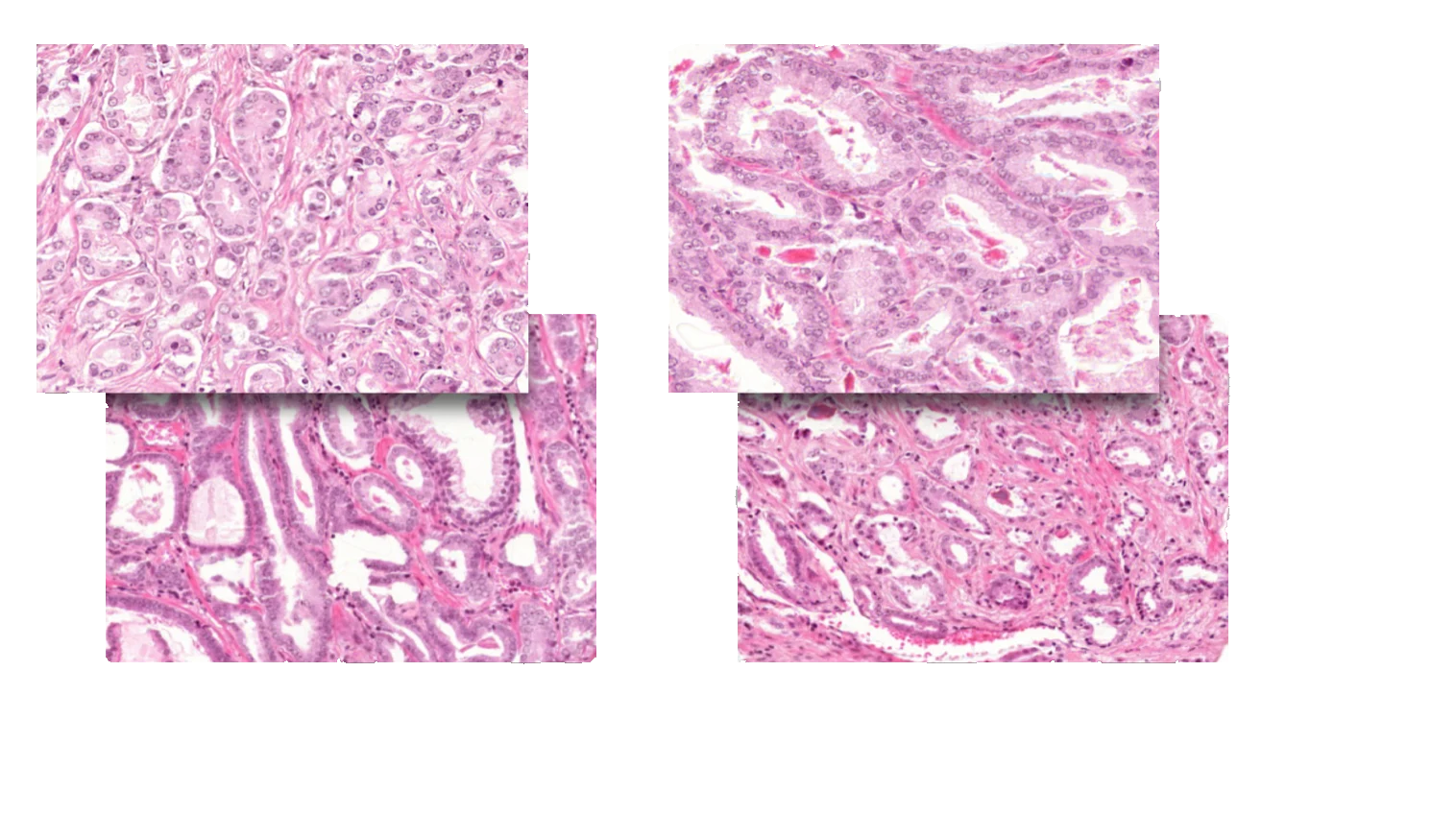
What does the Gleason score actually measure?
The Gleason score measures how different the cancer cells look compared with normal prostate tissue, based on architectural patterns. A pathologist looks into a microscope and assesses how deviant the cell structure is. It is an intuitive system with a long history, but it measures form, not function. It measures how the tissue looks, not with certainty what it will actually do. Where the method falls short in practice is described under the limitations of the Gleason method.
What does PCAI measure?
PCAI is trained directly on what happens to patients whose samples look a certain way. The system takes the tissue image as input and predicts the risk of clinical progression (recurrence, metastases, further treatment) based on actual patient outcomes; the method is validated in a study of 25,591 patients. Instead of asking "what does it look like?", PCAI asks "what usually happens to patients whose samples look like this?"
3 decisive differences
- Subjectivity: Gleason grading varies between pathologists and between occasions. PCAI consistently gives the same result for the same image, every time.
- Training data: Gleason is based on pathologist consensus and categorisation. PCAI is based on actual patient outcomes without a human subjective step in between.
- Resolution of the scale: ISUP gives five groups. PCAI gives a continuous index of 1–100, divided into seven statistically distinct risk groups, a finer division of risk levels.
What do the clinical data say?
In the study published in Medical Image Analysis 2025, PCAI and Gleason/ISUP were evaluated in parallel on three external test cohorts. PCAI outperformed ISUP on all three datasets:
| Cohort | PCAI's margin against ISUP |
|---|---|
| UPP (Uppsala) | 0.7 percentage points better in EOC-Index |
| MMX (Malmö) | 9.9 percentage points better than the expert average (AUROC5 0.869 versus 0.770) |
| UKE-sealed (826 patients) | 3.3 percentage points better in EOC-Index |
The differences were statistically significant (p < 0.01) in all comparisons.
Complement or replacement?
PCAI is a complement. Gleason grading is the clinical standard and is not changed by the fact that PCAI exists. Your urologist still makes the decision based on the clinical picture as a whole. PCAI offers an independent, data-driven voice in that discussion, a second opinion that does not depend on which pathologist reviews your sample.
You may also find answers here:
- See the full comparison table PCAI vs. Gleason
- Can AI really analyse cancer better than a specialist?
- PCAI clinical results in detail
Wondering what a PCAI index would show in your case?
We explain what the index and the risk level mean for your particular situation, free of charge, and you only order a second opinion if you feel afterwards that it is right for you.