
PCAI – AI-based analysis of prostate cancer
PCAI is an AI-based method that assesses prostate cancer aggressiveness on a 1–100 index with seven risk levels, built on outcome data from 17,700 patients.
Free digital meeting. You decide whether to go ahead.
A new method for analysing prostate cancer biopsies
The Prostate Cancer Aggressiveness Index (PCAI) offers a groundbreaking solution to one of the biggest problems in prostate cancer diagnostics: the lack of reproducible and precise analysis results from biopsies. Uncertainty in the analysis often leads to over- or undertreatment.
20% of patients in the ISUP 2 group receive radical treatment unnecessarily, while some cases of aggressive cancer are incorrectly recommended for active surveillance. PCAI addresses this problem by combining advanced AI with extensive medical expertise, resulting in a more reliable and reproducible analysis system.
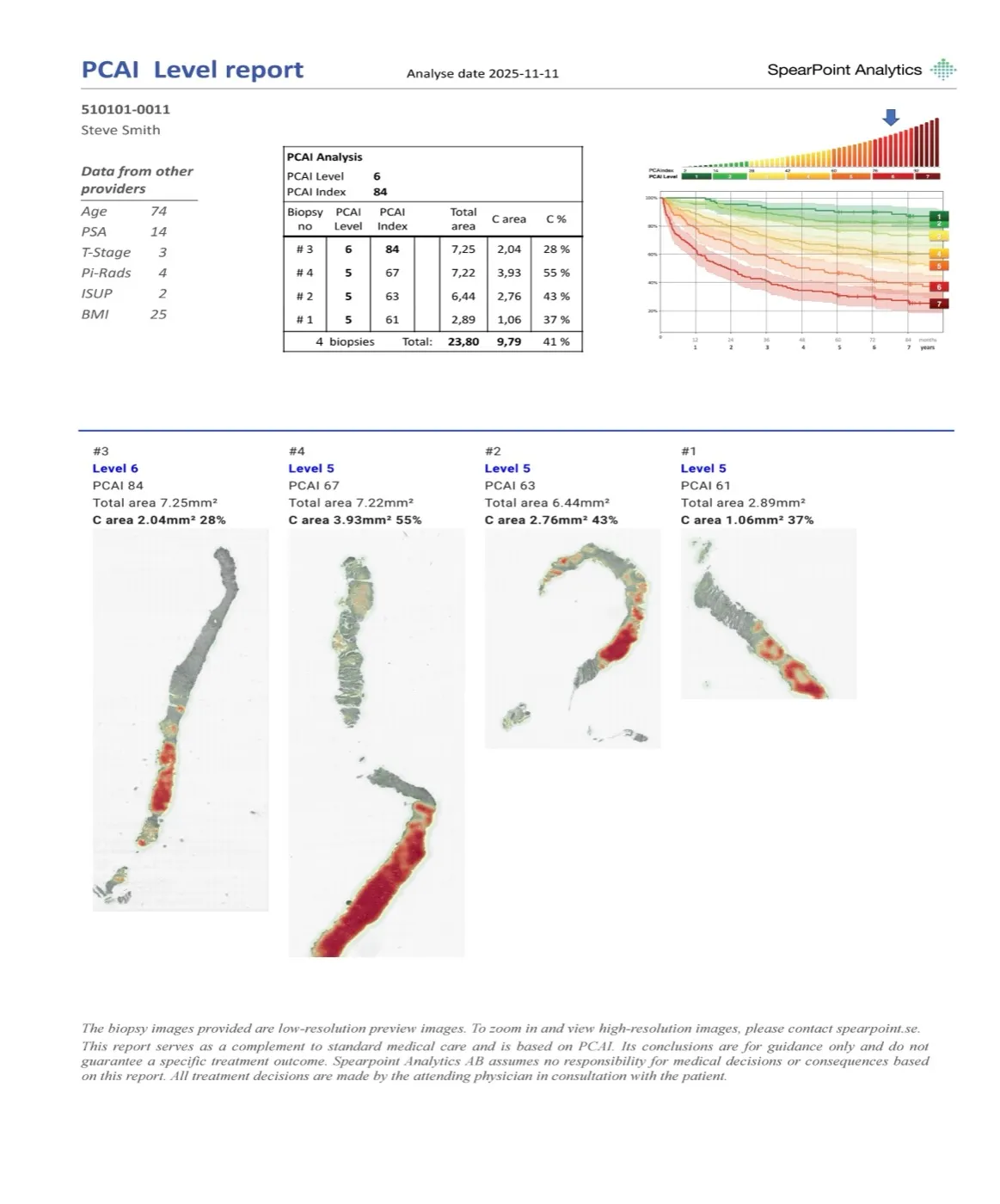
How PCAI works
PCAI analysis of biopsies delivers an index from 1 to 100 and classifies the results into seven different levels of aggressiveness. The system is trained on one of the world's most comprehensive databases, with up to 20 years of follow-up of 17,700 patient cases. The data comes from Martini Klinik in Hamburg. By comparing a patient's biopsies with this database, PCAI can identify the aggressiveness of the cancer based on the actual outcome.
1–100
index in seven risk levels, compared with the Gleason scale's 1–5
17,700
patient cases in the database behind the model
Regeldok v1.0 §4
Up to 20 years
follow-up time for the patients in the database
Regeldok v1.0 §4
This means that the result is based on what actually happened to patients whose samples resemble your tissue. Not on how they look according to a human assessment. The result is an accurate and consistent assessment of how aggressive your cancer is. Read more about the method in detail How PCAI works.
Robustness and precision
PCAI is robust with respect to different laboratory routines for section thickness, staining and the leading scanner models on the market. That is a more important property than it sounds: a method of analysis that gives different answers depending on which laboratory prepared the sample is not usable as a basis for decisions.
Research is under way to develop the analysis with parameters such as PSA PSA levels, Pi-RADS, the patient's age and so on, which will further improve the precision and personalisation of treatment recommendations. See the underlying evidence Clinical results.
What it gives you as a patient
- The result is given as an index, 1–100, compared with today's 1–5.
- The same biopsy gets the same result every time: the assessment is reproducible.
- Reassurance for you as a patient and the best possible basis for your urologist's decisions.
The difference from today's method is described side by side PCAI vs. Gleason, and the limitations of Gleason grading Limitations of the Gleason method.
A product of international collaboration
PCAI is developed by Spearpoint Analytics in collaboration with world-leading institutions in the prostate cancer field: Martini Klinik, the University Hospital in Hamburg and Akademiska Sjukhuset in Uppsala. The system has the potential to become the new standard for the analysis of prostate cancer.




The method rests on several years of published research Research & publications, and on those who stand behind it Partners.
What you will find here
Everything under PCAI
- How PCAI worksPCAI analyses your biopsy and gives an index of 1–100 in 7 risk levels, based on real patient outcomes. Read how it works – without unnecessary jargon.
- PCAI vs. GleasonPCAI gives the same result every time – Gleason varies depending on the pathologist. See how the methods differ in reproducibility, scale and scientific basis.
- Clinical resultsPCAI outperformed the expert pathologists' average by 9.9 percentage points (AUROC5) on the MMX cohort. Read the results from Uppsala, Malmö and Hamburg.
- Research & publicationsPCAI is published in Medical Image Analysis (November 2025). Read about the research behind the method and the seven scientific papers that support the service.
It is wise to find out more
Would you like to know what a PCAI analysis would mean in your case? The initial meeting is free of charge. If you feel afterwards that this is right for you, you can simply order a second opinion.
Related: How PCAI works | PCAI vs. Gleason | Clinical results | Research & publications