
What is Gleason grading?
To assess the aggressiveness of the cancer, a specialist doctor, a uropathologist, looks at images of tissue samples. An attempt is made to assess the structure of the tissue using a method from the 1960s. The aggressiveness is given on a scale of 1–5, where the sum of the two most significant areas forms a value.
How the grading is read off in a test result, together with PI-RADS and PSA, is described under making a diagnosis.
Where does the uncertainty arise?
The method is so complicated that two doctors can give different answers on the same tissue sample. The fact that the analysis is so difficult and uncertain means that the urologist has to work with margins. Even though most pathological analyses are reliable with modern techniques and experienced staff, studies show that errors can occur – particularly in the early stages of the disease or in difficult diagnoses.
The 1960s
the origin of the method
Up to 20%
of treatment decisions are assessed to be incorrect
Live copy
ISUP 2
the group where the uncertainty is greatest
The same Gleason grade – different aggressiveness
The clearest way to see the problem is to look at four samples that are graded the same.
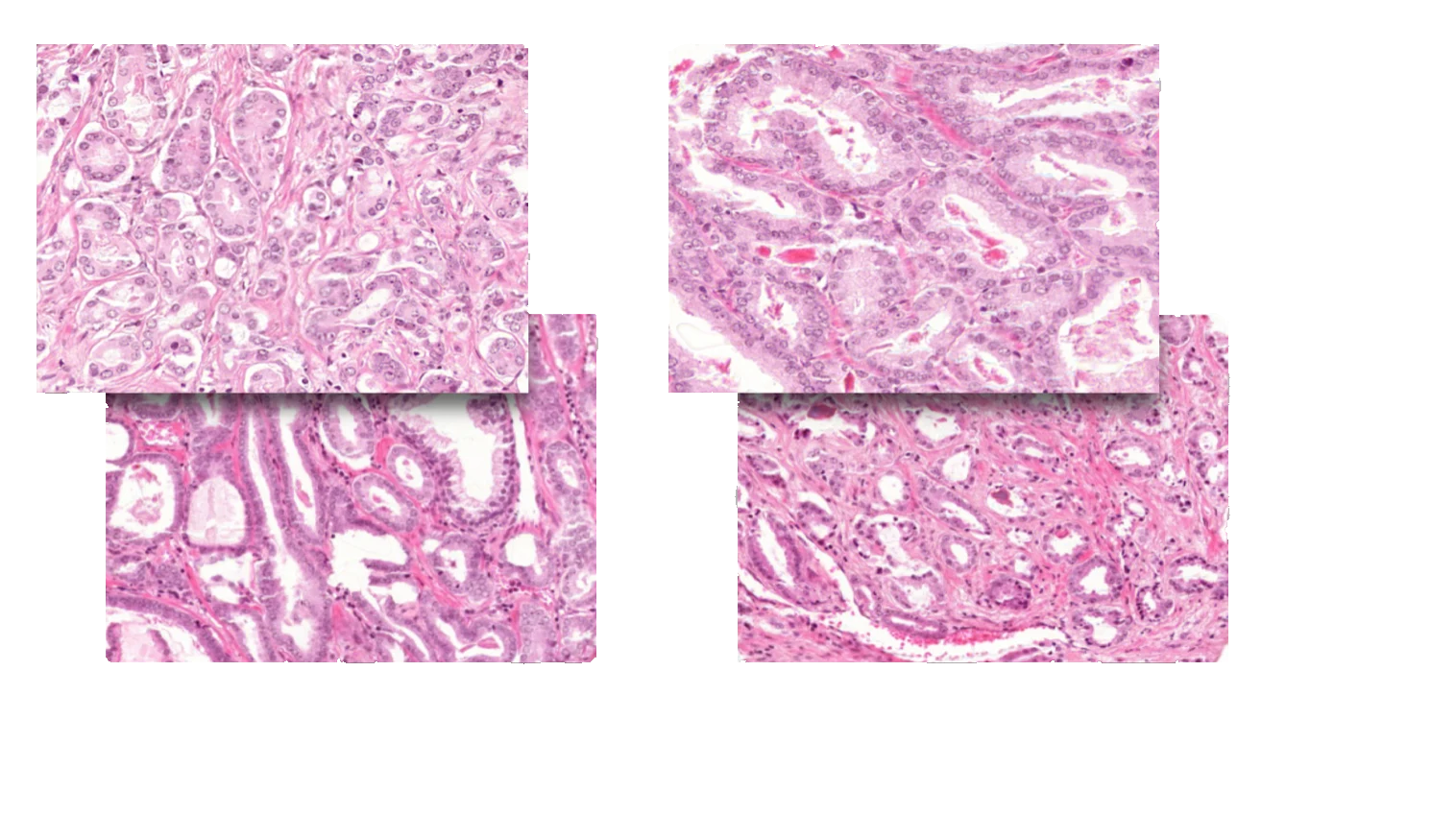
Four samples that look equivalent therefore lead to two completely different recommendations. The difference is not visible to the eye – but it is there in the outcome data How PCAI works.
Common questions about Gleason
Can two pathologists give different answers on the same sample?
Yes. Different pathologists can reach different conclusions, particularly when it comes to borderline cases. The method is complicated and the grading can differ between different pathologists – that is to say, two pathologists can arrive at different assessments of one and the same patient. In some cases a second assessment (second opinion) from another pathologist can be valuable in order to confirm the results What is a second opinion?.
What is the ISUP 2 grey zone?
The uncertainty is greatest in the ISUP 2 grey zone (Gleason 3+4). Up to 20% of patients in the ISUP 2 group receive radical treatment unnecessarily, while some cases of aggressive cancer are incorrectly recommended for active surveillance. Put differently: around 20% of those who are operated on today are operated on unnecessarily, "to be on the safe side".
Are further tests needed?
In some cases further tests or follow-ups are recommended in order to ensure a correct diagnosis and assessment. Which ones are relevant depends on your other values, such as PSA PSA levels and PI-RADS.
Why is the method still used?
Gleason grading is well established, requires no special equipment beyond a microscope and works well in the majority of cases. The problem is not that it is unusable, but that it is imprecise precisely where the decisions are most difficult.
What does it mean for you?
The consequences are serious in both directions: an unnecessary operation carries a risk of permanent impotence and incontinence, while a missed aggressive cancer can mean treatment that comes too late Surveillance vs. surgery. What you need is a more secure basis for a decision.
PCAI (Prostate Cancer Aggressiveness Index) provides an objective complement: the same biopsy always gets the same answer, regardless of which doctor looks at it. See the methods side by side PCAI vs. Gleason.
It is wise to find out more
Do you feel unsure about your grading? We will go through what your result means. The meeting is free of charge. If you feel afterwards that this is right for you, you can simply order a second opinion.
Related: PCAI vs. Gleason · How PCAI works · Making a diagnosis