
Investigation of suspected prostate cancer
PSA
From the age of 50, men should take the PSA blood test regularly. A raised level is often discovered in connection with an investigation for benign prostate enlargement or at a health check. Read more about the test PSA test and about how the level is interpreted PSA levels.
MRI
If the PSA level rises over time, an MRI, magnetic resonance imaging, is carried out. The cancer is given a PI-RADS value (1–5). The norm today is that PI-RADS ≥ 3 normally warrants further investigation.
Biopsies
Hollow needles capture tissue samples, biopsies, from the area with the tumour.
Analysis
Traditionally the biopsies are analysed by a pathologist, a specialist doctor. The analysis result gives the degree of aggressiveness. Today's method is imprecise and not reproducible. PCAI is the alternative modern method for a more exact and reproducible analysis of biopsies How PCAI works.
Decision
The aggressiveness of the tumour is absolutely decisive. Today's traditional method has shortcomings, which leads to unnecessary operations "just to be on the safe side" – or the opposite; missed tumours. PCAI gives a more precise analysis, which helps the urologist to choose correctly: safe follow-up or necessary treatment.
Follow-up or treatment
Follow-up can take place, for example, annually or every six months, with new PSA tests. Surgery as well as radiotherapy carries a risk of side effects such as incontinence and impotence Surveillance vs. surgery.
How does the pathologist assess the sample?
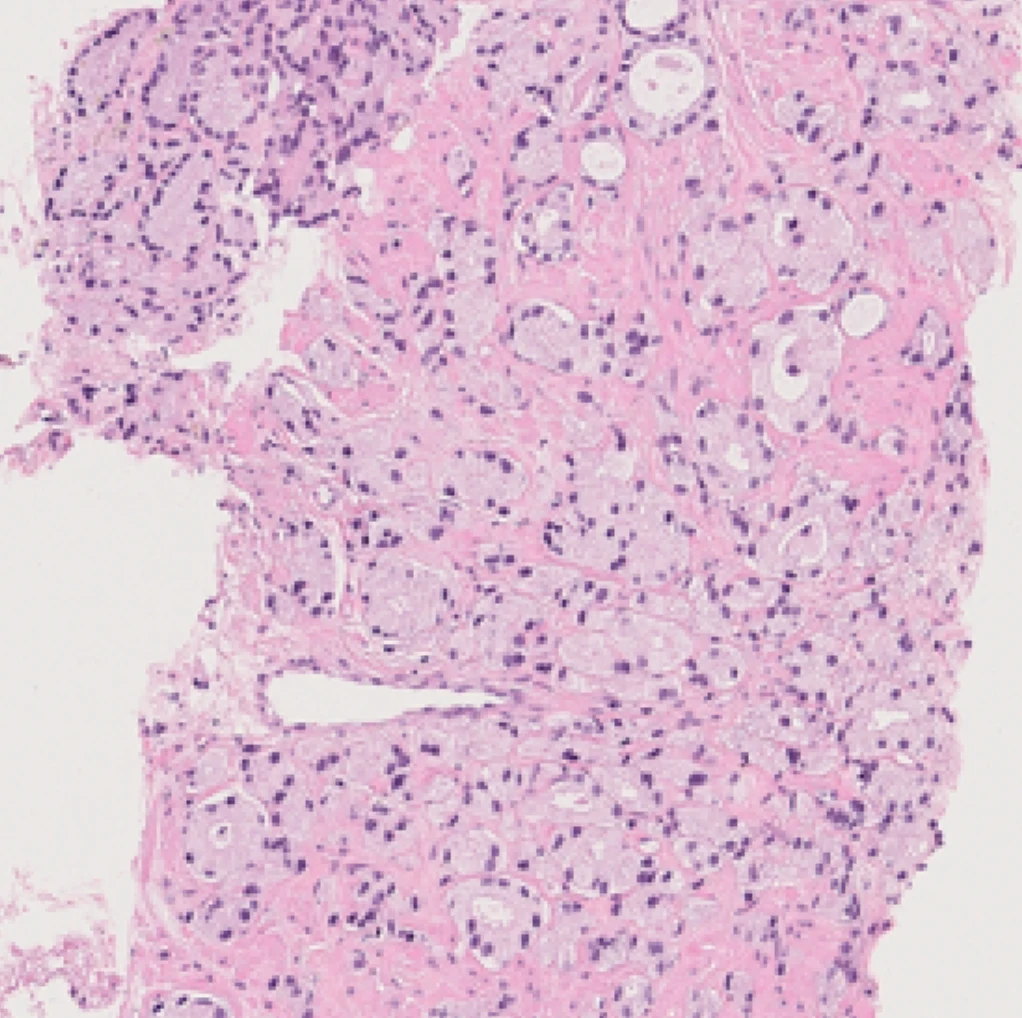
In a laboratory, thin sections are cut from the tissue sample and placed on glass slides. These sections are stained to bring out different cell structures, which makes it easier to see any abnormal cells. The slides are digitised in a scanner and magnified 200 times.
The pathologist analyses the shape, size and arrangement of the glands. Abnormalities can indicate cancer. A cancer is then classified and given a degree of aggressiveness Limitations of the Gleason method.
1–5
the Gleason scale's grading of aggressiveness
200x
magnification of the digitised tissue section
Live copy, not verified
PI-RADS ≥ 3
normally warrants further investigation
What each number in the result means
What is the ISUP grade?
The ISUP grade is the grouping that the Gleason grading is translated into. The sum of the two most significant areas forms a value – 3+3 is, for example, ISUP (International Society of Uropathologists) group 1.
- ISUP 1 is considered non-aggressive – these patients are followed up.
- ISUP 2 (3+4) – here it is considered whether radical treatment is required now or whether the patient can wait and be followed up.
- ISUP 3 (4+3) as well as ISUP 4 and 5 are considered aggressive and warrant treatment.
What does PI-RADS 5 mean?
PI-RADS is a scale of 1–5 that describes how likely it is that a change on the MRI image is a clinically significant cancer. PI-RADS 5 is the highest level and means that the finding has the features that most strongly indicate this. PI-RADS therefore says something about the likelihood of cancer – not about how aggressive it is. The aggressiveness is determined only when the tissue sample is analysed.
What is the Gleason score?
The Gleason score is the scale used to describe how different the cancer cells look compared with normal prostate tissue. It is based on what the gland structure looks like under the microscope and is given as 1–5, where the sum of the two dominant patterns makes up the answer. The method dates from the 1960s and has known limitations Limitations of the Gleason method.
How is prostate cancer graded?
Grading takes place in two stages. First the pathologist assesses the structure of the tissue under the microscope and assigns a Gleason grade, which is translated into an ISUP group of 1–5. That grading is then weighed together with your other values – PSA, T stage and PI-RADS – when the treatment is discussed.
The analysis of the biopsies determines the next step
The urologist's recommendation is based partly on your data, such as age, your PSA level, T stage and PI-RADS value (Prostate Imaging–Reporting and Data System) from MRI (Magnetic Resonance Imaging). The most important decision factor is the analysis of your biopsies, tissue samples; how aggressive is the cancer?
This has been done in the "first opinion" using the Gleason method, where the analysis results in a value of 1–5. It is a pathologist who has made an assessment of which category your cancer belongs to – a mild variant, Gleason 1, or an aggressive one, Gleason 5. The method is complicated and the grading can differ between different pathologists. That is to say: two pathologists can arrive at different assessments of one and the same patient.
It is precisely that uncertainty a second opinion is intended to reduce What is a second opinion?.
It is wise to find out more
Have you received your biopsy result and feel unsure? We will go through what it means. The meeting is free of charge. If you feel afterwards that this is right for you, you can simply order a second opinion.
Related: Limitations of the Gleason method · Common questions · How PCAI works