

What is prostate cancer?
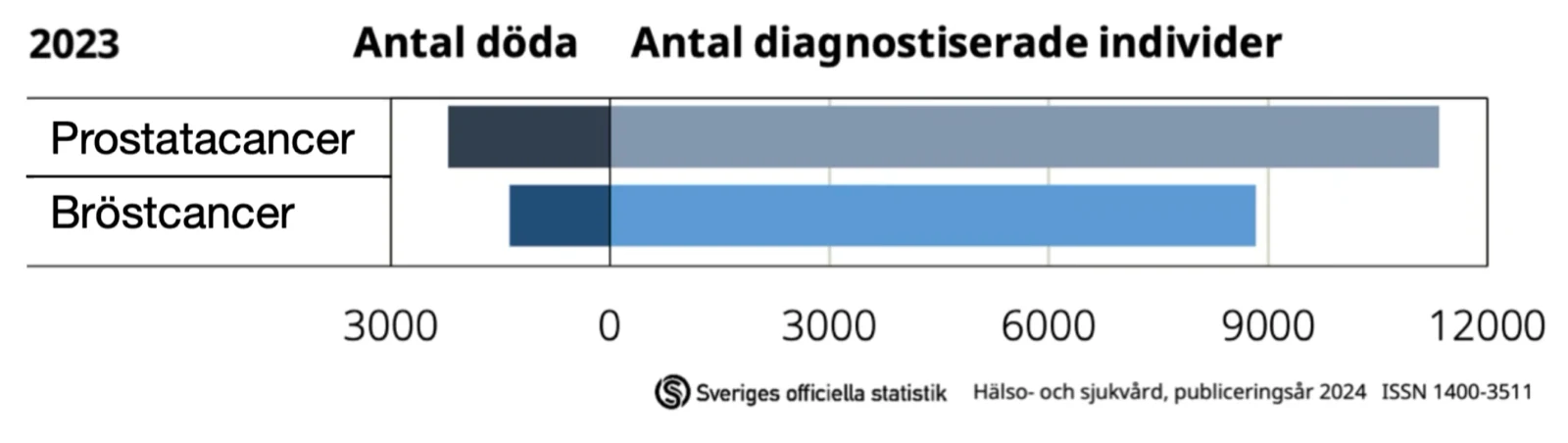
Prostate cancer is the most common cancer in Sweden. Prostate cancer is often slow-growing and not always life-threatening. Many men can live their whole lives with their cancer without ever noticing it. But if the cancer is aggressive it has to be dealt with so that it does not spread.
How common is it?
Thanks to early detection, improved options for follow-up and treatment, and medication, around 120,000 Swedish men live with the diagnosis. Each year about 11,000 men in Sweden are diagnosed with prostate cancer.
120,000
Swedish men live with the diagnosis
The national care programme
11,000
are diagnosed each year in Sweden
The national care programme
One in five
men who reach the age of 80 receives the diagnosis
The national care programme
The incidence rises sharply with increasing age. More than one in five Swedish men who reach the age of 80 receives the diagnosis, while the disease is rare before the age of 50.
Risk factors
The most important risk factors for prostate cancer are increasing age and heredity. Heredity is a well-studied and strong risk factor: men who have a father or a brother with prostate cancer have roughly twice as high a risk of developing the disease as men without prostate cancer in the family. The more close relatives who have been affected, and the younger they were when they were affected, the higher the risk.
Symptoms
Most men who receive a prostate cancer diagnosis have no symptoms from the cancer. Instead they have received their diagnosis because of a raised level of the blood test PSA in connection with an investigation for benign prostate enlargement or at a health check.
Why the diagnosis matters
A very large proportion of the prostate cancer that is diagnosed after PSA testing is what is known as low risk or intermediate risk, with a good prognosis over many years even without treatment. Many men with such prostate cancer should not be treated, but only followed up.
Patients with an aggressive cancer that is not treated run a risk of mortality within 5–10 years of diagnosis. The degree of aggressiveness of the cancer is therefore the most important factor when deciding on treatment – and that is precisely where today's methods have shortcomings. Read more about how the diagnosis is made Making a diagnosis and about the limitations of the Gleason method.
What treatments are available?
For those men who are recommended radical treatment there are usually several different types of treatment to choose between: surgery, external radiotherapy or internal radiotherapy. For men with low-risk or intermediate-risk prostate cancer there is, from a medical point of view, no hurry with the treatment decision; for some of them a long period for treatment discussions is of value.
Most men with high-risk cancer can be treated with either surgery, radiotherapy, hormonal treatment, focal treatment or a combination of these. Patients need to discuss their treatment with both a urological surgeon and an oncologist, who administers radiotherapy.
Prostate cancer with confirmed spread is treated medically with hormonally acting drugs or surgically. Where the spread is limited, local radiotherapy directed at the prostate tumour may be an option.
The trade-off between treating now and following up is described in more detail under active surveillance or surgery.
Source: National care programme for prostate cancer. Information on heredity as a risk factor: Prostatacancerförbundet (prostatacancer.se).
It is wise to find out more
Have you received a diagnosis and feel unsure about the next step? The meeting is free of charge. If you feel afterwards that this is right for you, you can simply order a second opinion.
Related: Making a diagnosis · Common questions · Surveillance vs. surgery