
Gleason grading and PCAI measure the same thing, but on a different basis. Read about the limitations of the Gleason method for the background.
The same Gleason grade, different aggressiveness
The clearest way to see the difference is to look at four samples that a pathologist would grade the same.
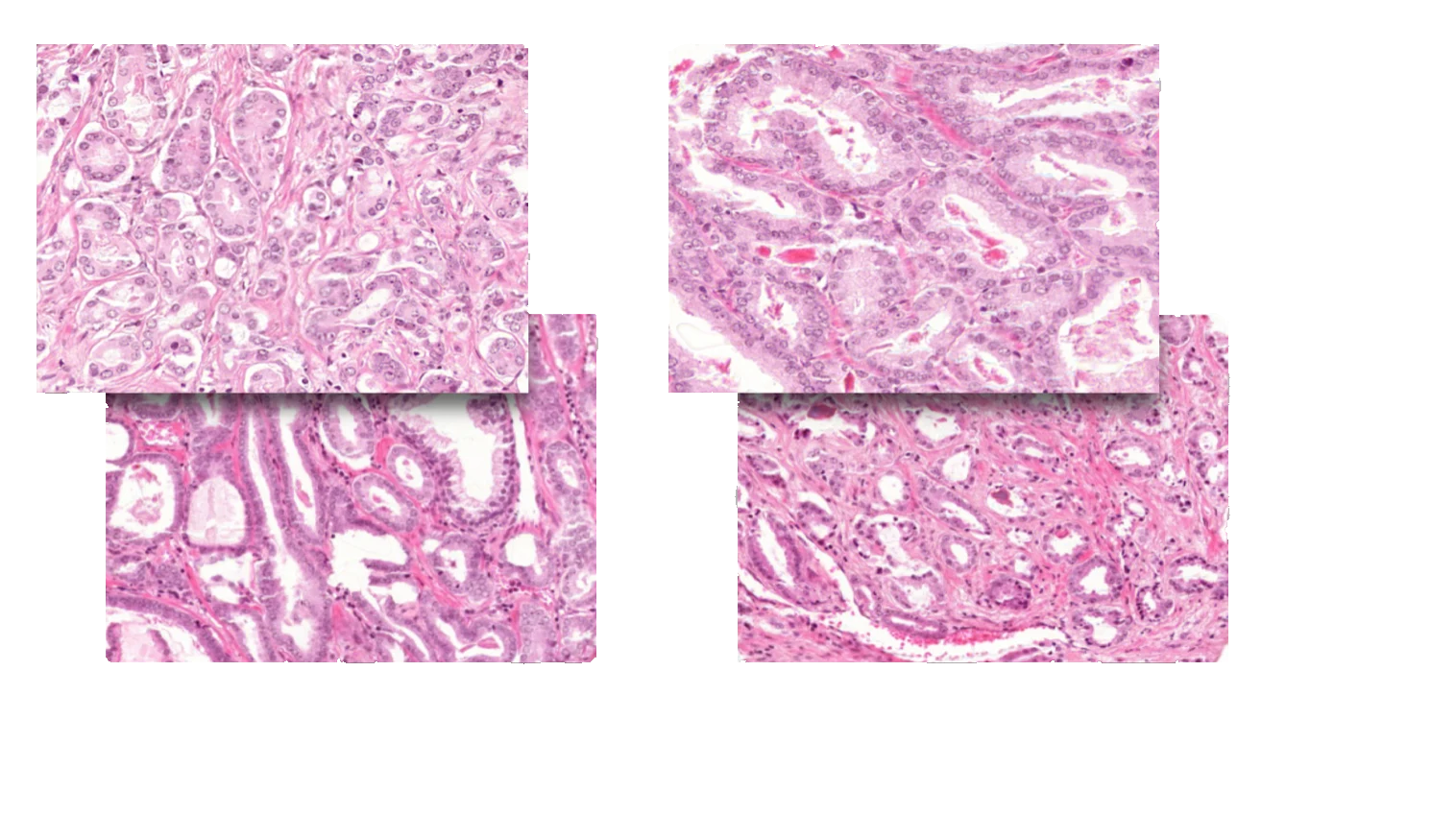
Four samples that look equivalent to the eye thus lead to two completely different recommendations: follow-up for the first two, treatment for the last two. That is the difference PCAI is built to capture.
The comparison point by point
| Property | Gleason grading | PCAI |
|---|---|---|
| Method | Subjective human assessment | AI analysis trained on patient outcomes |
| Scale | 1–5 (ISUP groups) | Index 1–100, 7 risk levels |
| Reproducibility | Varies by pathologist | Consistent, always the same answer |
| Scientific basis | Subjective expert assessment, 1960s | Peer-reviewed (Medical Image Analysis, MIA), Nov 2025 |
| Evidence base | Not applicable | 25,591 patients, up to 23 years (the MIA study) |
| ISUP 2 grey zone | High risk of incorrect decisions | Objective complement, reduces incorrect decisions |
| Precision vs. pathologists | Reference measure | +9.9 pp versus the expert average (MMX, AUROC5) |
pp = percentage points. MIA = Medical Image Analysis. Source: Fuhlert et al., Medical Image Analysis, November 2025 Research & publications.
1–5
the resolution of the Gleason scale
1–100
PCAI's resolution, in seven risk levels
The same answer
every time the same biopsy is analysed
What the difference means in practice
Safer and better analysis than experienced pathologists on all external test cohorts, and the same biopsy always gets the same answer. Reproducibility is the point: when two assessors can arrive at different answers on the same sample, the urologist has to work with margins, and margins become, in practice, unnecessary operations or missed tumours.
How the analysis is carried out in detail is described under how PCAI works How PCAI works, and the evidence behind the figures under clinical results Clinical results.
Why doesn't PCAI replace Gleason entirely?
PCAI is undergoing the IVDR approval process Implementation in order to be implemented directly in laboratories. Today Spearpoint offers PCAI as a second opinion to the patient What is a second opinion? as a complement to, not a replacement of, the original Gleason grading.
It is wise to find out more
Wondering what a PCAI result would mean for your particular diagnosis? The initial meeting is free of charge. If you feel afterwards that this is right for you, you can simply order a second opinion.
Related: Clinical results · Limitations of the Gleason method · Research and publications