
How does PCAI work? AI analysis of prostate cancer
PCAI analyses your biopsy and gives an index of 1–100 in 7 risk levels, based on real patient outcomes. Read how it works – without unnecessary jargon.
Free digital meeting. You decide whether to go ahead.
What PCAI does
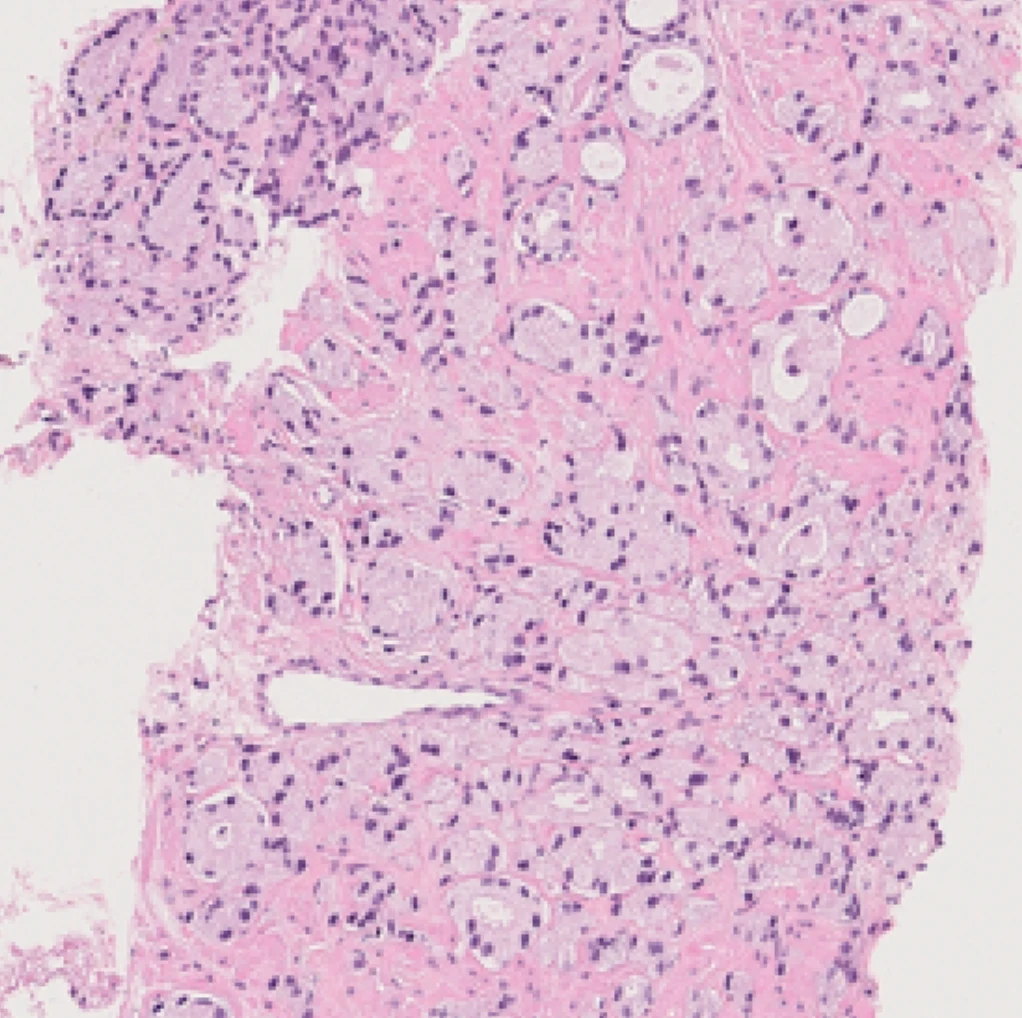
PCAI (Prostate Cancer Aggressiveness Index) is an AI model that analyses images of prostate biopsies and gives an objective measure of the aggressiveness of the cancer. PCAI is trained on one of the world's most comprehensive prostate cancer databases: data from Martini-Klinik in Hamburg, one of the world's leading clinics in prostate cancer treatment. The database contains biopsies and outcome data from 17,700 patients followed for up to 20 years.
This means that PCAI does not guess: it compares your biopsy images with real patient cases whose outcomes are known. Do your biopsies resemble patients who had aggressive cancer, or those whose cancer never required treatment? That is the same question that today's Gleason grading tries to answer, but with the limitations Limitations of the Gleason method that a single assessor's eye brings with it. See how the methods differ in our direct comparison, PCAI vs. Gleason PCAI vs. Gleason.
1–100
index in seven levels of aggressiveness
17,700
patient cases with known outcome in the database
Regeldok v1.0 §4
Up to 20 years
follow-up behind every comparison
Regeldok v1.0 §4
An assessment based on what actually happened
This is the decisive difference, and it is worth saying plainly. With our Second Opinion method, the assessment has been made based on your data, but with a method of analysis that is built on how things went for a large number of patients.
This means that your biopsy images have been compared with patients whose outcomes PCAI knows. Your biopsies therefore resemble a population of patients in the database who had a course of cancer that motivates the recommendation you were given in your second opinion.
By comparing a patient's biopsies with this database, PCAI can identify the aggressiveness of the cancer based on the actual outcome, not on how the tissue is judged to look in the moment.
From biopsy to index
Cancer detection with SPCD.
Before the PCAI analysis is run, our cancer detector SPCD (Spearpoint Cancer Detector) identifies the cancer areas in the biopsy images with over 95% precision (AUROC 0.94) and isolates the relevant tissue regions.
PCAI analysis.
PCAI analyses the morphology of the cancer regions (the shape, structure and arrangement of the cells) with deep learning algorithms and compares them against the database. The result is an index of 1–100.
Medical review.
The result is reviewed by Spearpoint's urologist, who documents the assessment and presents it in a written report with a patient section and a medical section.
The whole process, from the first meeting to the finished report, is described step by step How does it work?.
The 7 risk levels
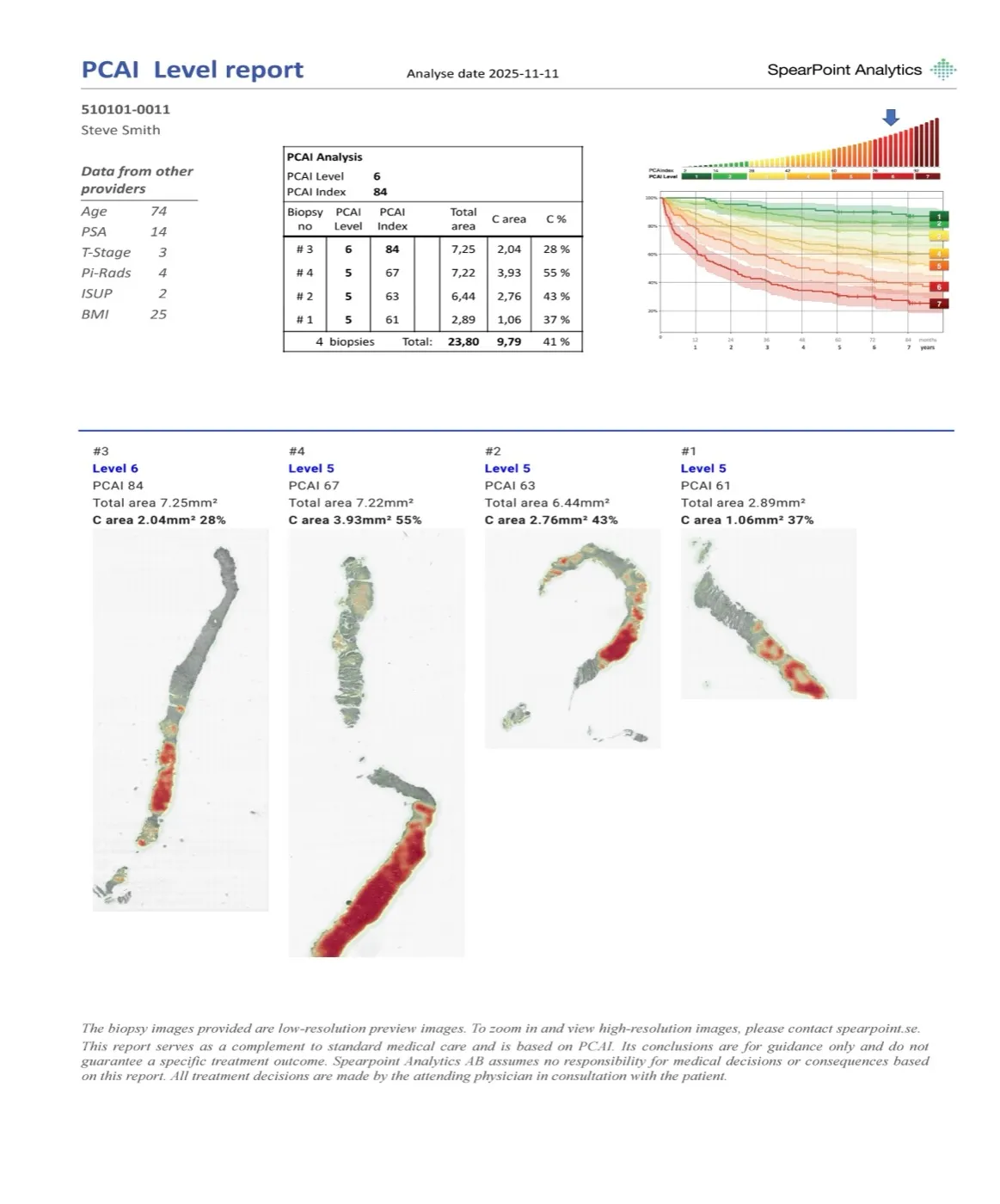
The PCAI index is divided into seven risk levels:
- 1–20: Very low aggressiveness
- 21–35: Low aggressiveness
- 36–50: Moderately low aggressiveness
- 51–65: Moderate aggressiveness
- 66–75: Moderately high aggressiveness
- 76–85: High aggressiveness
- 86–100: Very high aggressiveness
Where on the scale a result falls determines whether active surveillance is reasonable or whether radical treatment should be considered Surveillance vs. surgery. The assessment is always made together with your urologist and your other values, such as PSA PSA levels.
What makes PCAI robust?
PCAI is robust to variations in laboratory routines: section thickness, staining and the leading scanner models on the market. The system is designed to work consistently in a real clinical environment, not only in controlled test environments. Where other AI models can lose accuracy with such variation, PCAI retains its precision. The clinical results Clinical results show how the method stands up against experienced pathologists in independent test cohorts.
It is wise to find out more
We will go through what a PCAI analysis would mean in your situation. The meeting is free of charge. If you feel afterwards that this is right for you, you can simply order a second opinion.
Related: How an analysis works, step by step How does it work? · What a second opinion involves · The research behind it Research & publications